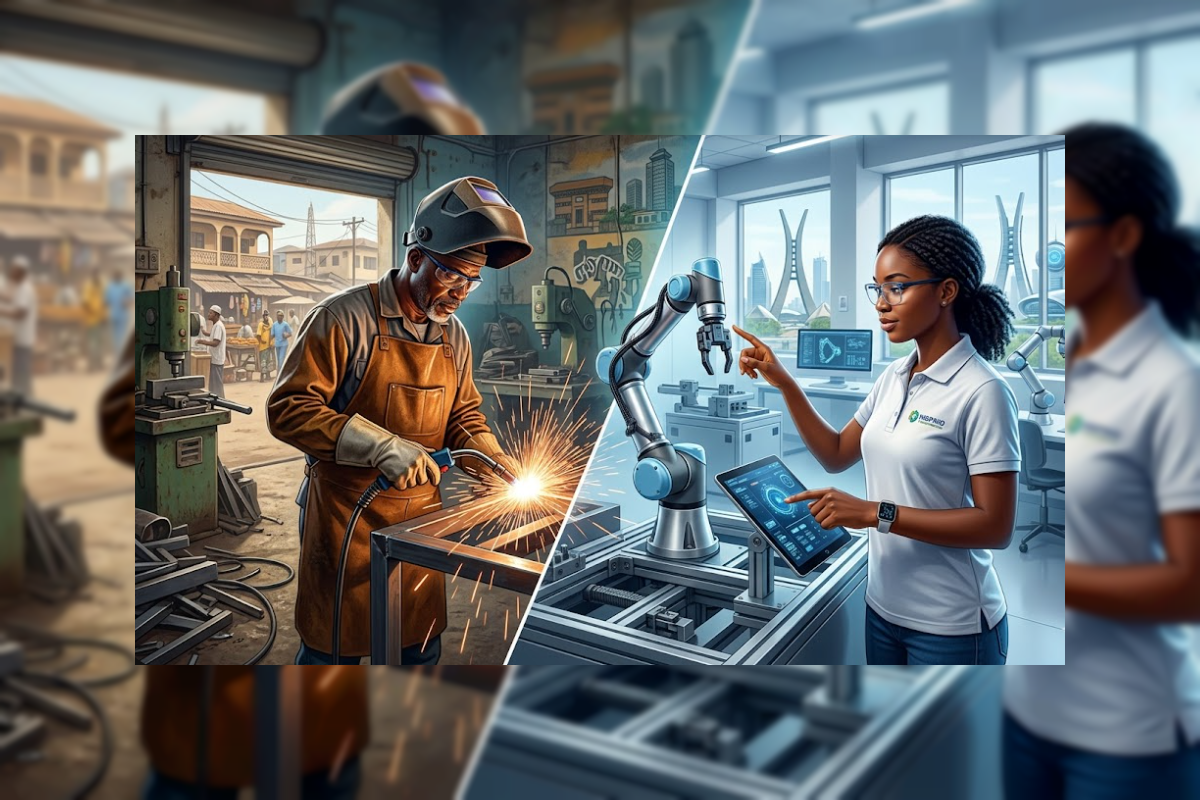

The smell of burning electrodes and molten iron always smelled like success to Baba Tunde.
For more than three decades, his modest fabrication workshop in Yaba, Lagos, stood as a testament to hard work, resilience, and technical excellence. Armed with an aging welding machine, a toolbox worn by years of service, and an exceptional understanding of machinery, Baba Tunde could repair almost anything. From damaged vehicle chassis to industrial flour-processing equipment, he had earned a reputation as one of the most skilled craftsmen in his community.
Yet despite his expertise, he often felt overlooked.
Across the street worked an engineer with a prestigious university degree. While Baba Tunde spent his days building, repairing, and solving real-world mechanical problems, his neighbor managed projects from an office desk. Society seemed to value the degree more than the practical skills that kept industries running.
"They have the theories, Tunde," his late father would often tell him. "But you have the hands that build the nation."
Years later, Baba Tunde found himself sitting in the auditorium of Yaba College of Technology (YABATECH), watching his daughter, Amina, walk across the graduation stage. She was receiving her Higher National Diploma (HND) in Mechatronics Engineering.
As she delivered her valedictory speech, she spoke passionately about robotics, automation, artificial intelligence, and smart manufacturing systems. She described a future where machines could diagnose faults, optimize production, and revolutionize agriculture.
At that moment, Baba Tunde realized something remarkable.
Technical education in Nigeria had evolved.
The story of polytechnics was no longer just about learning trades. It had become a story of innovation, technology, and economic transformation.
The Origins of Polytechnic Education in Nigeria
To understand the modern role of polytechnics, it is important to examine their historical foundation.
Before Nigeria gained independence in 1960, the colonial education system focused primarily on producing administrative personnel. Schools were designed to train clerks, interpreters, and civil servants who could support government operations.
However, as independence approached, Nigeria faced a pressing reality. A growing nation required more than administrative workers. It needed engineers, technicians, builders, and innovators capable of developing critical infrastructure.
Roads needed construction. Factories needed skilled operators. Power plants required maintenance. Industrial growth demanded technical expertise.
To meet these demands, institutions such as Yaba Technical Institute, later renamed Yaba College of Technology, and Kaduna Polytechnic were established. Their mission was straightforward: produce highly skilled technical professionals capable of driving national development.
Unlike traditional universities, polytechnics emphasized practical learning. Students spent significant time in workshops, laboratories, and industrial training programs where they developed hands-on experience.
This approach quickly made polytechnics a vital component of Nigeria’s educational and industrial landscape.
The HND vs BSc Debate in Nigeria
As the years passed, polytechnic education encountered a significant obstacle.
A divide emerged between holders of Higher National Diplomas (HNDs) and Bachelor of Science degrees (BSc).
Although both qualifications required years of rigorous academic study and practical training, HND graduates frequently faced discrimination in employment and career progression.
- Limited promotion opportunities for HND holders
- Salary differences between graduates performing similar roles
- Reduced public perception of polytechnic education
- Declining interest among students and parents
As a result, many talented students viewed polytechnics as a second-choice option rather than a deliberate educational pathway.
Despite these challenges, polytechnics continued to fulfill their core mission.
While universities often emphasized theoretical concepts, polytechnic students remained deeply engaged in practical problem-solving. They learned to design systems, operate machinery, troubleshoot equipment, and implement technical solutions that directly impacted industries.
The Digital Revolution and the Renaissance of Polytechnics
The rise of technology and the Fourth Industrial Revolution dramatically changed global workforce demands.
Employers increasingly sought professionals who could do more than understand concepts. They needed individuals who could apply knowledge, build solutions, and adapt to rapidly evolving technologies.
This shift placed polytechnic graduates in a stronger position.
Recognizing the importance of technical education, policymakers, educational stakeholders, and industry leaders began advocating reforms aimed at modernizing polytechnic institutions and reducing the long-standing HND-BSc divide.
At the same time, polytechnics themselves evolved.
The traditional focus on mechanical trades and technical maintenance expanded into emerging fields that define the modern economy.
Key Areas of Innovation in Modern Nigerian Polytechnics
- Artificial Intelligence (AI) and Machine Learning
- Software Engineering and Cybersecurity
- Renewable Energy Technology
- Mechatronics and Robotics
- Advanced Agricultural Technology
- Digital Manufacturing Systems
- Industrial Automation
For students like Amina, this evolution means gaining skills that extend far beyond traditional technical trades.
She learned not only how to weld metal components but also how to program robotic systems capable of performing those same tasks with extraordinary precision.
The Role of Polytechnics in Nigeria’s Economic Growth
As Nigeria continues to diversify its economy, polytechnics are becoming increasingly important.
The country faces significant challenges, including unemployment, industrial development, infrastructure expansion, and technological advancement.
Addressing these challenges requires a workforce equipped with practical skills and innovative thinking.
Polytechnic graduates are uniquely positioned to contribute because they are trained to:
- Design and build technical solutions
- Operate and maintain industrial systems
- Create innovative products and services
- Launch technology-driven businesses
- Support local manufacturing initiatives
- Drive industrial innovation
Across Lagos, Abuja, Port Harcourt, Kano, and other emerging economic centers, employers are actively seeking graduates who can contribute immediately without extensive retraining.
This demand has elevated the relevance of polytechnic education in ways that were unimaginable decades ago.
The Future of Technical Education in Nigeria
The future of polytechnics in Nigeria appears increasingly promising.
As global economies prioritize innovation, automation, entrepreneurship, and digital transformation, technical education is becoming more valuable than ever.
Government reforms, industry partnerships, startup ecosystems, and technological advancements are creating new opportunities for polytechnic graduates.
The institutions themselves are evolving into innovation hubs where students can develop prototypes, launch startups, conduct applied research, and solve real-world problems.
Back in Yaba, Baba Tunde’s workshop still operates.
But it has transformed.
With Amina's expertise in automation and digital diagnostics, the family business has evolved from a simple repair shop into a thriving fabrication and engineering company.
Together, they represent two generations of technical excellence—one built on traditional craftsmanship and the other powered by modern technology.
Their story reflects the broader transformation of polytechnic education in Nigeria.
Today, the polytechnic pathway is no longer viewed as an alternative route. It is a strategic choice for future innovators, creators, engineers, and entrepreneurs.
The future of Nigeria will not be built by theory alone.
It will be designed, engineered, programmed, fabricated, and powered by skilled professionals whose education combines knowledge with practical application.
And at the heart of that future stand Nigeria’s polytechnics.



Comments (0)
No comments yet. Be the first!
Please login to leave a comment
Login to Comment